
Blog · Other Transactions
Paid Only From Proven Savings: The CDAO Pilot With Red Cell Partners
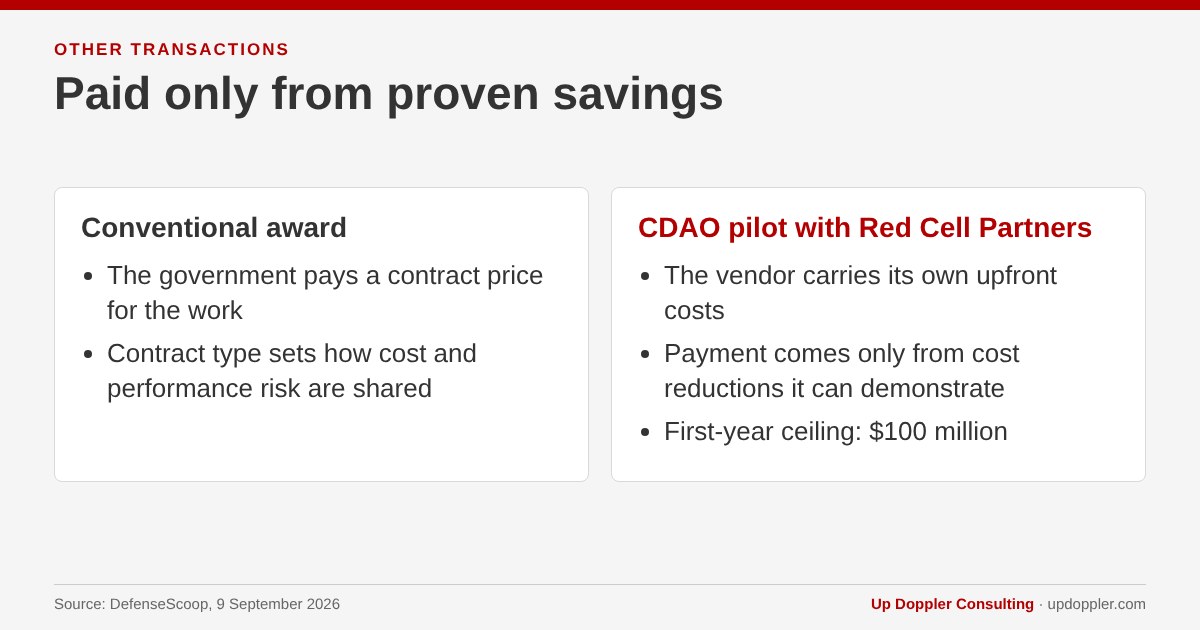
A new pilot from the Chief Digital and Artificial Intelligence Office ties payment to verified savings rather than to a separately funded price for the work. Under an other transaction agreement with Red Cell Partners, a venture studio in McLean, Virginia, the vendor carries its own upfront costs and collects only from cost reductions it can demonstrate it produced for the Department. The first-year ceiling is $100 million.
What the pilot pays for
The work is built around artificial intelligence tools. The example offered publicly is an audit agent whose output let the Air Force cancel consulting contracts it already held. That is the result the model rewards: a cost that existed before the tool arrived and is gone afterward.
Who carries the risk
Conventional awards spread cost and performance risk in different ways depending on contract type. Here the government spends nothing on effort, and the vendor bears the full risk that its tools fail to produce a saving that counts. A company that accepts those terms needs the capital to fund the work until savings are recognized, and confidence that they will be recognized at all.
Measurement decides everything
The weak point is counting. Before a shared savings agreement can work, both parties have to settle how the baseline is set, which reductions belong to the vendor, and who verifies the final figure. Those terms cannot sensibly be left until after award, because the vendor's entire payment depends on them.
The arrangement is still a pilot, not a standing contract vehicle. UDC recommends that companies interested in the model follow how the CDAO defines and verifies savings, because those terms, more than the dollar ceiling, will decide whether the approach spreads and which firms can afford to compete under it.
Closing Rate tracks moves like this one and explains what they change for companies selling to DOW. Subscribe to get the analysis as it publishes.
First published in Closing Rate on September 9, 2026. Read the original.
Subscribe to Closing Rate