
Blog · Cost and Pricing
Feinberg Memo Seeks Cost Visibility Below the Prime on Negotiations of $10 Million and Up
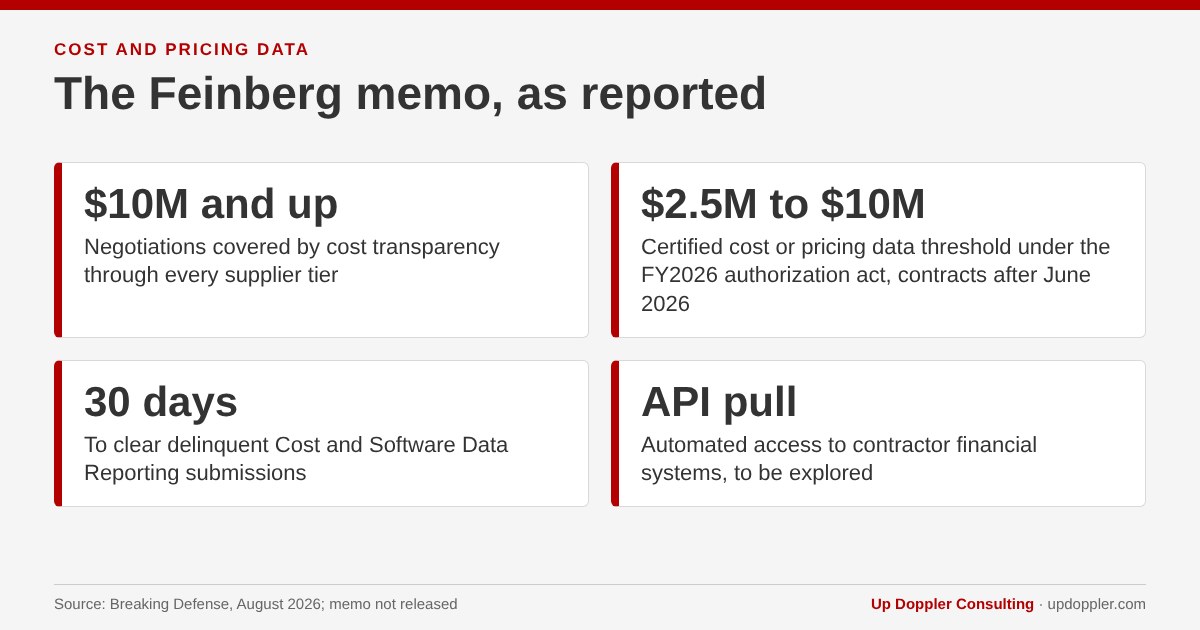
The fiscal year 2026 authorization act lifted the threshold for certified cost or pricing data from $2.5 million to $10 million. A memo signed by Deputy Secretary Steve Feinberg points the other way on visibility. According to reporting that a Department official has verified as authentic, the memo extends cost transparency to every tier of the supply chain, covering contractors and subcontractors alike, for negotiations of $10 million or more, regardless of whether certified data is required. The memo has not been made public.
What the memo directs, as reported
- Profit by line: the Under Secretary for Acquisition and Sustainment is to establish fair and reasonable profit margins for each product or service line, drawing on commercial best practices.
- Direct data access: the same office is to explore an automated way to draw cost information straight from contractors' financial systems.
- Delinquent reports: the memo says thousands of Cost and Software Data Reporting submissions are overdue and allows 30 days to clear them.
How the data would move
The reported text frames the automated option as a burden reducer: application programming interfaces that pull cost information directly from a contractor's enterprise resource planning system or other financial systems, in place of manual submissions. The memo went to senior department leaders and the directors of defense agencies and field activities. It also says the department does not intend to limit profit when a contractor finds efficiencies after negotiating a fair and reasonable price from a realistic baseline.
John Ferrari, a retired Army major general and senior nonresident fellow at the American Enterprise Institute, read the tool narrowly. In his view it would standardize how companies send cost data, much as a taxpayer files a return electronically, rather than give the government open access to company systems. He also warned that the department would need people who can interpret the data, since artificial intelligence applied without that expertise can produce exactly the wrong answer.
Where the CSDR data goes
The memo ties the delinquent Cost and Software Data Reporting submissions to a specific use: assessing the quality of sole-source contracts over time. It says the backlog impairs the department's ability to judge which programs deliver the most value and which need adjustment. For a sole-source prime, current CSDR data is the record the department will use to evaluate its pricing.
What remains open
The memo does not explain how an automated system would be built or funded. The Aerospace Industries Association has said the measures being considered would slow delivery. Those are real gaps, but they concern method, not intent.
The industry response was pointed. The Aerospace Industries Association said the approach "risks adding years to acquisition timelines" and works against Congress's recent modernization efforts. The context it points to is real: the higher certified-data threshold in the FY2026 authorization act applies to contracts awarded after June 2026, so the memo arrives just as the statutory burden was supposed to ease.
What it means for subcontractors
The clearest signal is reach. A requirement that applies to subcontractors through every tier brings cost questions to firms that may never have dealt directly with a government pricing team. UDC recommends that primes confirm their CSDR submissions are current, and that subcontractors on negotiations at or above the reported $10 million threshold review whether their cost records could support a request passed down from the prime, before that request arrives.
Closing Rate tracks moves like this one and explains what they change for companies selling to DOW. Subscribe to get the analysis as it publishes.
First published in Closing Rate on August 21, 2026. Read the original.
Subscribe to Closing Rate