
Blog · Uncrewed Systems
Materials, Performance, Eligibility: Sorting Out a Foreign-Sourced Drone Motor
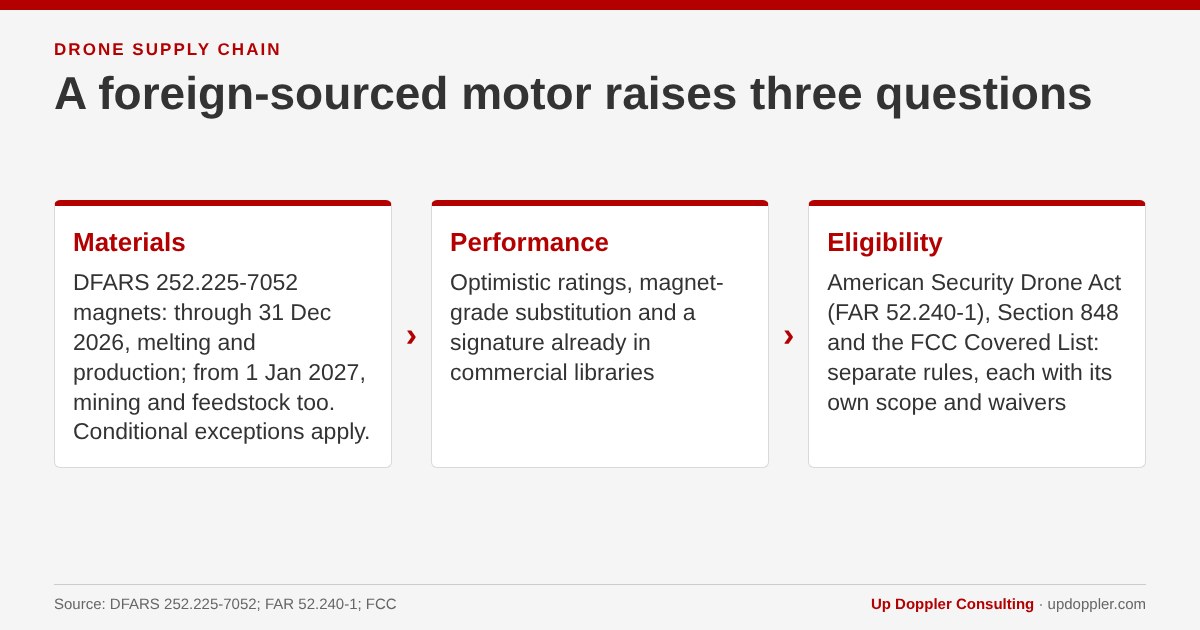
SiFly has closed a $20 million Series A to start production of its Q12. The motors still come from China, and the company's chief executive says reshoring them completely is not physically possible. Most readers will file that under supply chain. UDC sees three separate questions behind it, each with a different owner and a different deadline, and a program that answers one has made no progress on the other two.
The company behind the example
The details in DroneXL's report make SiFly a useful case because they are specific. Shield Capital led the round, joined by Qudit, BBK Capital and Alumni Ventures among others, and the chief executive, Brian Hinman, says it buys about 18 months of runway. SiFly expects to ship roughly 1,000 Q12s in 2027 from a 15,000-square-foot site it is negotiating to lease in Sunnyvale, California, with first revenue deliveries targeted for the first quarter of 2027. At the aircraft's May 2025 unveiling the company had targeted deliveries in the fourth quarter of 2025. The Q12 is a 30-pound quadcopter built for endurance; it set a Guinness World Record of 3 hours and 11 minutes in July 2025.
The supply chain under it is mixed. Motors come from China and batteries are assembled in Malaysia. Hinman puts the cost of assembling the motors in the United States from globally sourced parts at about three times the current price, and higher again under domestic-content rules that reach deeper into the chain. On the military's interest in magnets made from American-mined rare earths, he was blunt: "That's just not physically possible today."
Question one: what is in the magnet
Brushless drone motors are permanent-magnet machines, and the neodymium-iron-boron feedstock their magnets need is concentrated abroad. DFARS 252.225-7052 restricts covered magnets in two stages:
- Through 31 December 2026: the restriction reaches melting and production.
- From 1 January 2027: it extends back through mining and ore or feedstock, recycled material included.
The rule moves on a fixed date while the hardware stays the same, so a part that complies today can fall outside it on New Year's Day. The clause carries conditional exceptions, including for certain commercial off-the-shelf items and electronic devices and for nonavailability determinations, so the test is the clause text applied to the specific part. UDC recommends qualifying any bill of materials this autumn against the 2027 standard, since a supplier change forced after award is the expensive way to fix it.
Question two: what the motor actually does
A drone motor seldom arrives on its own. It comes paired with an electronic speed controller running firmware, on a bus shared with the flight controller. Three issues follow that a commodity trade study will miss:
- Ratings: published Kv, continuous current and thermal figures are often optimistic.
- Magnet grade: substituting a grade shifts the demagnetization threshold, and the effect appears at altitude or in high ambient heat rather than on the test bench.
- Signature: the motor and controller largely determine the acoustic and electromagnetic profile that counter-UAS libraries use to classify a drone. Fly a motor that is common on the commercial market and an adversary's library may already hold its signature.
Question three: whether the aircraft can be sold at all
This is the question that can end the discussion, and it involves several authorities that are easy to blur. The American Security Drone Act, enacted in the FY2024 NDAA and implemented at FAR Subpart 40.2 and the clause at FAR 52.240-1 effective 22 December 2025, restricts federal procurement and operation of unmanned aircraft systems manufactured or assembled by covered foreign entities as the clause defines them. Section 848 of the FY2020 NDAA separately restricts DOW procurement of systems from covered foreign countries and systems that use specified components from them. The FCC put foreign-produced unmanned aircraft systems and their critical components on the Covered List in December 2025, which governs equipment authorization rather than procurement, and on 11 August 2026 it revoked an equipment authorization for the first time.
Each authority has its own scope, exceptions and waiver process, and a motor's origin matters differently under each. UDC recommends determining which prohibitions actually reach the specific system, and whether any exemption, exception or waiver applies, before pricing anything. A sourcing plan alone confers no eligibility.
Putting the three together
Each question needs its own answer: a sourcing plan that meets the 2027 magnet rule, test data on how the motor and controller behave in the conditions the customer cares about, and a clear position on eligibility under each authority that applies. UDC recommends working all three in parallel, since a fix on materials does nothing if the system is barred on other grounds.
The SiFly numbers also show why the third question cannot be deferred. A company that has slipped one delivery date, is funded for 18 months and is negotiating its first production lease cannot afford to discover after a federal order that the airframe is ineligible. Battery supply has already been squeezed once: Chinese sanctions in 2024 cut off the supplier behind Skydio's batteries. UDC recommends that any drone maker courting DOW buyers write down, part by part, which of the three questions each foreign-sourced component raises, and fund the answers in that order: eligibility first, materials second, performance third.
Closing Rate tracks moves like this one and explains what they change for companies selling to DOW. Subscribe to get the analysis as it publishes.
First published in Closing Rate on August 30, 2026. Read the original.
Subscribe to Closing Rate