
Blog · Trade and Tariffs
Section 232 Drone Tariffs: The Rates, the Dates and the Country Caps
Drone builders already work under procurement restrictions on what DOW may buy. A presidential proclamation issued 13 August adds a separate lever: import duties on unmanned aircraft systems and their components under Section 232 of the Trade Expansion Act of 1962. It rests on a Secretary of Commerce report finding that these imports arrive in quantities and under circumstances that threaten to impair national security.
The rates and when they apply
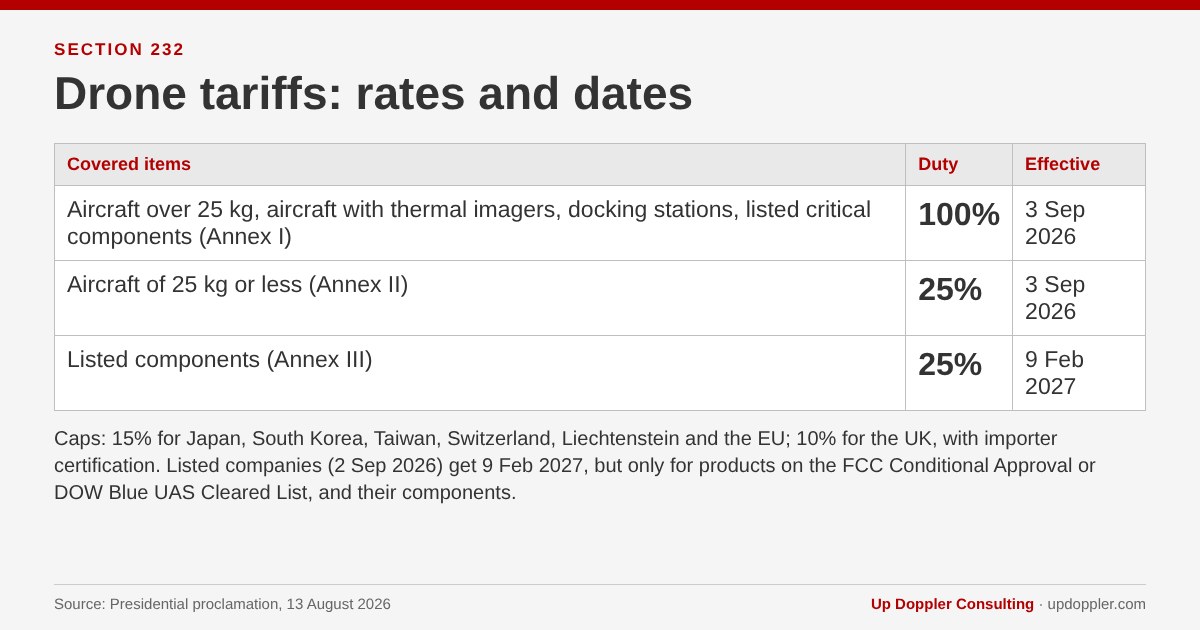
| Covered items | Duty | Effective |
|---|---|---|
| Unmanned aircraft over 25 kg, aircraft that integrate thermal imagers, docking stations and critical components, as listed in Annex I | 100% | 3 September 2026 |
| Unmanned aircraft of 25 kg or less, as listed in Annex II (thermal-imager aircraft fall in the 100% row) | 25% | 3 September 2026 |
| Components listed in Annex III | 25% | 9 February 2027 |
Except as the proclamation otherwise specifies, these duties apply in addition to any other duties, taxes and fees owed.
What Commerce found
The findings are worth reading because they explain which parts are targeted. The Secretary of Commerce found that even drones assembled in the United States depend on foreign motors, electronic speed controllers, lithium-ion batteries and docking stations. The report also cites software in some foreign products that sends data back to the manufacturer through a factory-installed operating system the operator cannot control, and concludes that domestic capacity could not support a wartime surge.
Lower caps for allied sources
Products of Japan, South Korea, Taiwan, Switzerland, Liechtenstein and the member states of the European Union are capped at 15 percent, a ceiling that includes the regular (Column 1) duty rate. Products of the United Kingdom are capped at 10 percent. Both caps depend on the importer certifying that substantially all critical components and technology come from those countries or from the United States.
A later date for listed companies
Clause 7 matters to DOW suppliers. For companies on the DOW Blue UAS Cleared List, the Blue UAS Framework or the FCC Conditional Approval List as of 2 September 2026, clause 7 moves the clause 1 effective date to 9 February 2027, but only for the products and components clause 7 specifies: products on the FCC Conditional Approval List or the DOW Blue UAS Cleared List, and their components. UDC recommends checking both the company's eligibility and the product's own qualifying listing, and having the importer of record confirm classification. A company's listing alone does not establish that a particular import receives the later date.
The onshoring program
Commerce is to run an incentive program for companies building new United States capacity. An approved onshoring plan must commit to build, refurbish or expand a domestic facility producing drones or drone components, with construction before 20 January 2029. In return, the company may import covered products and production equipment without the Section 232 duty while the facility is under construction, in volumes matched to the plant's expected annual output. Commerce will weigh whether the company already holds a DOW or DHS Conditional Approval, the realism of its schedule and production projections, and how the benefit is shared among applicants. Approved plans are monitored. Benefits can be rescinded for substantial shortfalls, and retroactively where fraud is found.
The list can grow
The Secretary may add components to the tariff on a rolling basis by Federal Register notice, after finding that the imports threaten the national security objectives of the proclamation; it may seek input from domestic producers and industry first. Commerce also owes the President a status update within 120 days of the proclamation. A bill of materials that clears the annexes today should be rechecked against each notice.
Why a tariff is a different problem
Sourcing rules and duties hit at different points. The first limits the buyer's options at award; the second raises landed cost at the port of entry, whoever the end customer is, commercial or government. Meeting DOW sourcing rules does not by itself change tariff treatment. Relief comes only through the proclamation's own clauses: the allied-country caps, the later date for listed companies under clause 7 and the onshoring program under clause 6, each with its conditions.
The February 2027 component duty is the window. UDC recommends that manufacturers map which of their imported components fall under the proclamation, check whether their suppliers can support the allied-country certification, and use the months before 9 February to move sourcing where the numbers require it.
For companies planning a domestic plant, the onshoring program changes that calculation. UDC recommends that a manufacturer with real expansion plans compare the duty it would pay against the documentation and monitoring an approved plan requires, and align that plan with any FCC Conditional Approval filing, since Commerce is directed to streamline the two.
Closing Rate tracks moves like this one and explains what they change for companies selling to DOW. Subscribe to get the analysis as it publishes.
First published in Closing Rate on August 13, 2026. Read the original.
Subscribe to Closing Rate