
Blog · SBIR
Skipping Phase I: What USSOCOM's Two Direct to Phase II Topics Ask of a Small Business
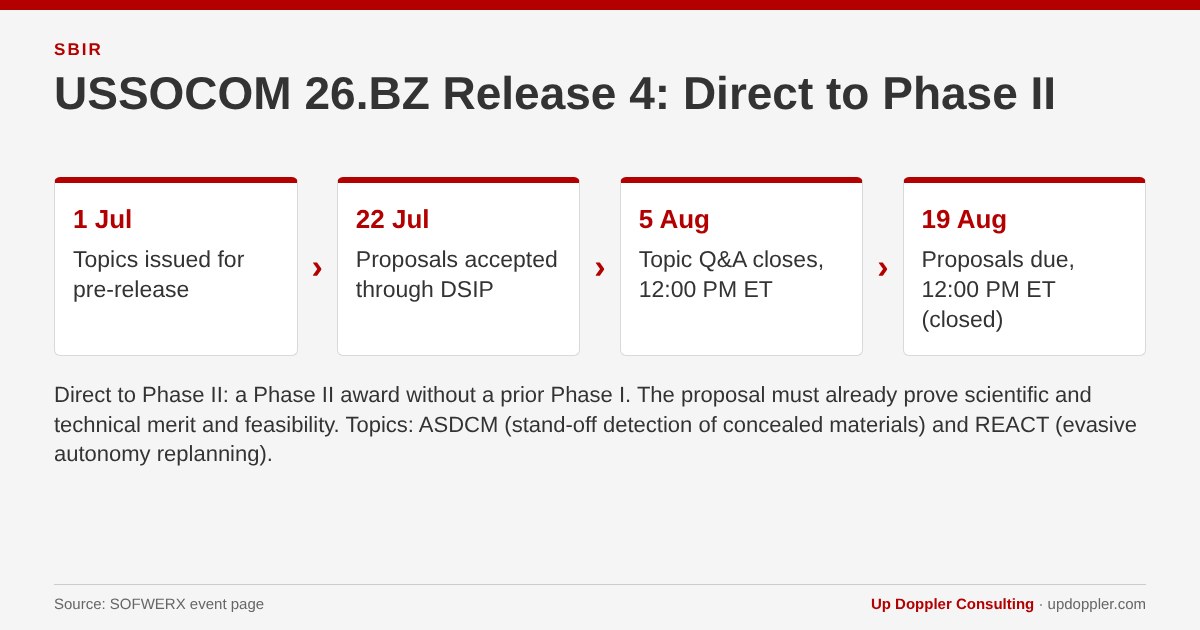
A small business with mature technology and no Phase I award usually waits for the right Phase I topic. USSOCOM's SBIR 26.BZ Release 4 offers a way around that wait, with a deadline of 12:00 PM Eastern on 19 August 2026.
The two topics
The SOFWERX event page lists both topics:
- SOC26BZ04-DV004, Advanced Stand-off Detection of Concealed Materials (ASDCM): detecting concealed materials from a distance.
- SOC26BZ04-DV005, Replanning for Evasive Autonomy to Counter Threats (REACT): autonomy that replans in response to a threat instead of flying the route it was given before launch.
The SOFWERX event page lists the timeline:
| Date (2026) | Milestone |
|---|---|
| 1 July | Topics issued for pre-release |
| 22 July | USSOCOM begins accepting proposals through the Defense SBIR/STTR Innovation Portal (DSIP) |
| 5 August | DSIP topic Q&A closes to new questions, 12:00 PM ET |
| 19 August | Proposals due no later than 12:00 PM ET |
What Direct to Phase II actually requires
Under the program description on the same page, the Department of War may make a Phase II SBIR award to a small business that did not receive a Phase I SBIR or STTR award for that work. The proposal itself must demonstrate the scientific and technical merit and feasibility of the idea. Phase I exists to establish exactly those things with a small investment. A Direct to Phase II proposer has to show it has already done that work on its own.
That makes the challenge one of documentation more than technology, and it is where nontraditional companies most often fall short. Strong prototypes lose when the proposal does not prove what they have already demonstrated.
Use the Q&A transcripts
The question period has closed, but SOFWERX posted transcripts of the ASDCM and REACT Q&A telecons next to the topic instructions. UDC recommends reading both before writing a word. They reveal which readings the government has already rejected, something no amount of careful inference can supply.
Update: this submission window closed on 19 August 2026. The test below applies to the next direct-to-Phase II release.
A realistic test before a short window
Seven days is enough to assemble a proposal if the underlying feasibility work exists, and far too little to create it. A company that has relevant prototype maturity and has been waiting for a Phase I topic in its area should look hard at this path. A company that would need to generate its feasibility evidence now should wait for a better fit.
Closing Rate surfaces SBIR, STTR and other small-business windows with enough lead time to act. Subscribe to get the next one while there is still time to respond.
First published in Closing Rate on August 12, 2026. Read the original.
Subscribe to Closing Rate